Introduction to ADTTA Table Tennis League
The ADTTA Table Tennis League season runs from late September or early October until the end of April, with the ADTTA Annual General Meeting (AGM) held in May, providing an opportunity to review the recently completed season and discuss plans for the season ahead.
The League currently consists of four divisions, with more than 30 teams and around 150 players taking part each season.
Depending on the number of teams in each division, players can expect to play between 14 and 18 league fixtures per season. Each team traditionally plays every other team in its division twice: once at home and once away.
While many participating clubs are based in Aberdeen, the League also includes teams from Stonehaven, Inverurie, Peterhead and Turriff. As a result, all teams should be prepared to travel for away fixtures. Car sharing is common practice and is recommended, particularly for longer journeys.

Requirements for the clubs
According to ADTTA Constitution, in order to be recognised as a club by ADTTA, the club must have a named Organiser, suitable premises, be open to new members and be affiliated to TTS.
A suitable venue typically offers enough space to play comfortably (ideally at least 5 × 10 meters), a flat and level floor (wood, PU, PVC or vinyl), sufficient ceiling height (a minimum of 3 meters, with 5 meters or more being ideal), good lighting (700 lux or higher is recommended), and a competition-style table fitted with a quality net assembly that is correctly tensioned and set to the proper height.
In practice, visiting players are generally understanding and appreciate that not every venue can meet these ideal standards. However, many playing conditions can be improved, often with relatively modest changes and limited resources, making the experience better for both regular and visiting players.
Clubs’ TTS affiliation is separate to players’ affiliation, costs £25 per season and can be purchased online via the TTS website. The Club Secretary should arrange this at the start of each season to ensure the club is covered from an insurance viewpoint.
Registering teams
Each team must have a minimum of three registered players to enter the League. However, registering at least four players is strongly recommended. This makes it easier to fulfil fixtures throughout the season, provides greater flexibility in team selection, and helps cover last-minute unavailability, injuries or illness.
There is no maximum limit on the number of players that can be registered for a team. In practice, however, most teams find that having between four and six registered players offers the best balance between ensuring availability and providing everyone with regular playing opportunities.
ADTTA handicap tournaments
Once the table tennis season is well underway, typically in December, the ADTTA handicap competitions begin. Two handicap tournaments are built into the league calendar: the KO Cup and the League Cups (each division has it’s own League Cup).
The main difference between the two competitions is that the KO Cup is open to teams from all divisions, while the League Cup is contested only between teams within the same division.
In both competitions, matches are played as a single game to 41 points, with the winner needing only a one-point advantage. To create a more even contest, the stronger player starts on 0, while the lower-rated player is awarded a calculated number of handicap points before the game begins. The handicap is based on the difference in playing standard, giving both players an equal opportunity to win.
Rules for the ADTTA KO Cup
(9 singles, first team to win 5 games)
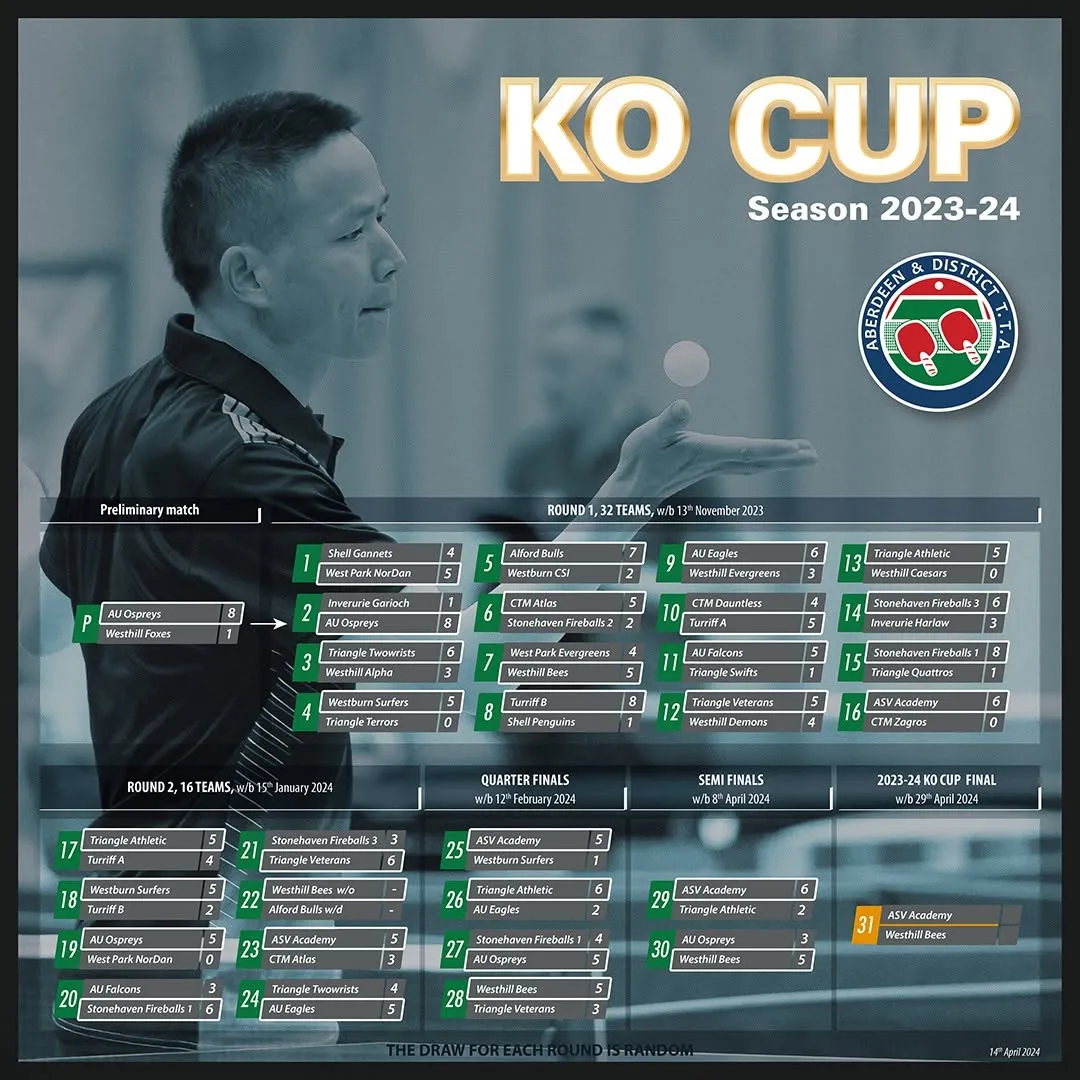
All teams from all ADTTA divisions are included in the the KO Cup. It starts right away with a KO stage, although sometimes a preliminary round is needed. Fixture’s scorecard contains 9 single games, each played up to 41 points, and the conclusion of a fixture is when a team wins 5 games.
Players eligible to play for a team in the KO Cup are those registered for that team, or players ‘playing up’ from a lower division of the same club. Any players doing so will be cup-tied and only eligible to play for the same team thereafter. Players are not allowed play in the KO Cup for more than one team, even if they transfer between teams during the season.
Rules for the ADTTA League Cup
(6 singles & 1 doubles, first team to win 4 games)
As in the KO Cup, individual matches are played as a single game to 41 points. However, the overall match format is different. A League Cup fixture consists of six singles matches and one doubles match, with the first team to win four matches declared the winner. Teams are competing for the following trophies:
- Division 1: NORTH of SCOTLAND SHIELD
- Division 2: GRAMPIAN TROPHY
- Division 3: GRANITE CITY SHIELD
- Division 4: BON ACCORD TROPHY
Only players who are registered for a team are eligible to represent that team in the League Cup.
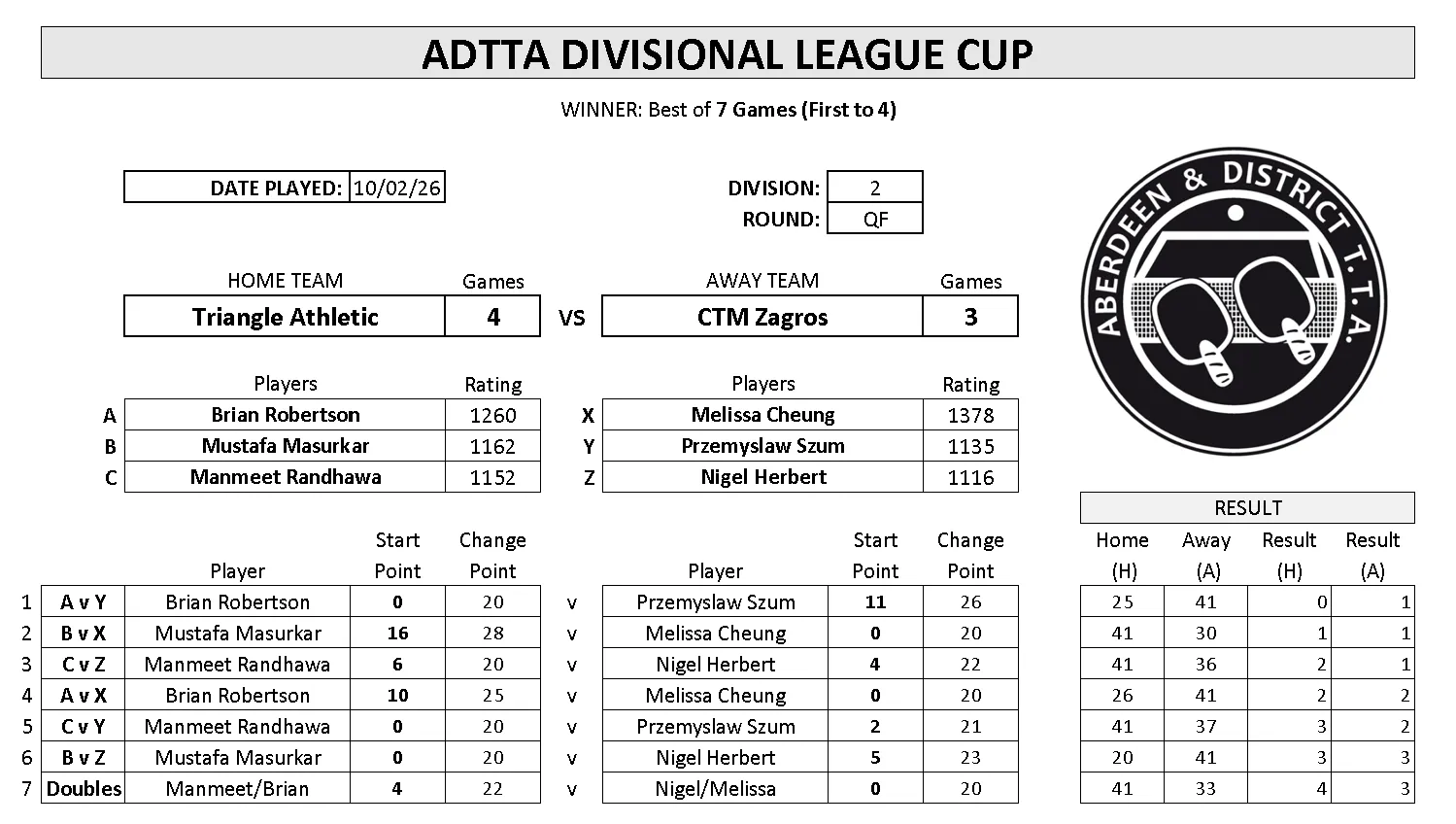
- Matches will be between teams of three players, each playing one game up to 41 points, against each member of the opposing team. A fourth player may play doubles in the League Cup.
- A game is deemed to be complete when either player has scored 41 points. This means that a player can win 41-40.
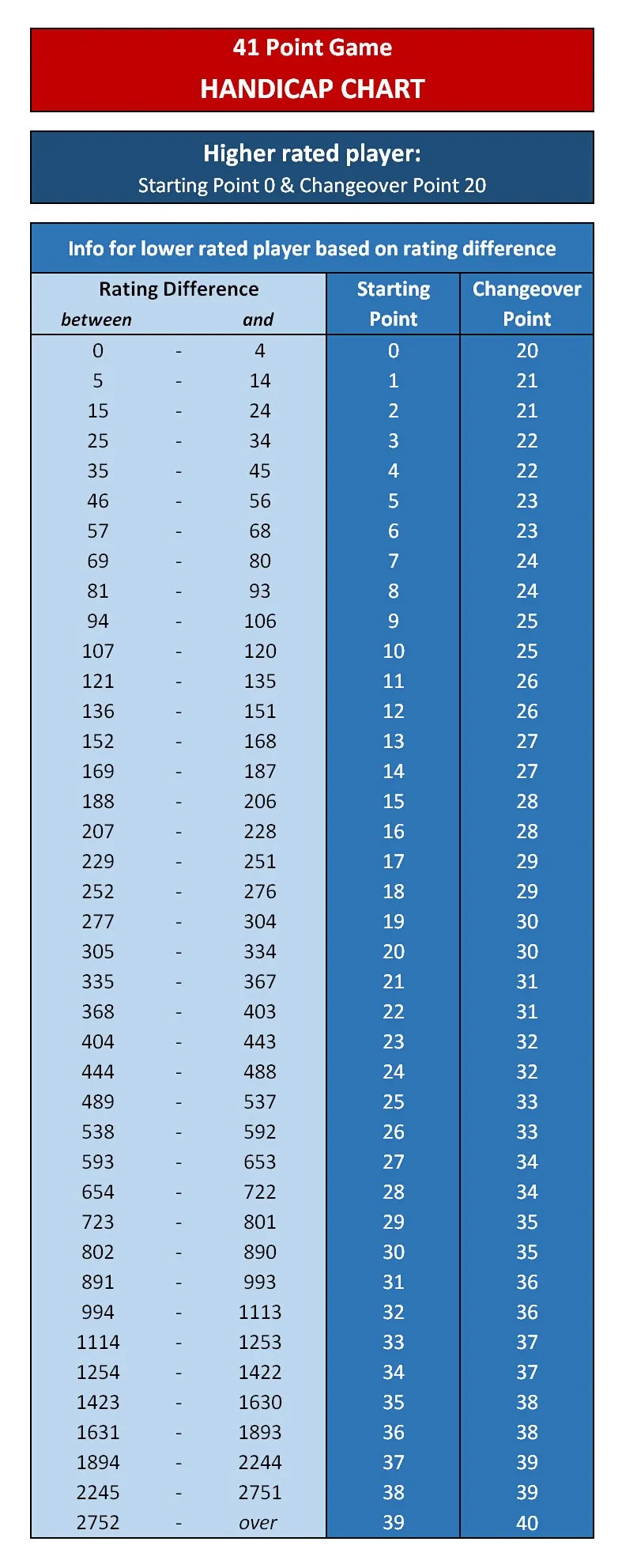
- All games will start with the higher rated player starting at 0. The other player will start at a score relative to the difference in the ratings of the players (between 0 and 35). A table is provided below to enable calculation of the starting point of the lower rated player. Note: this will be different for every opponent you play.
- Service will change after each multiple of 2 (two) points scored, including the starting score (so if the starting point of the lower rated player is an even number then the first person serving will have 2 serves, if an odd number the first person serving will have 1 serve. From that point on serves will change every 2 serves.
- Players will change ends during the game. The end change always takes place when the first player reaches their change end point. The higher rated player always has a change end point of 20, and the lower rated player has a change end point related to their starting point, as provided in the table.
- For doubles, an average of both players ratings should be taken to find out the rating of the pair together. Players should be arranged in order of rating with the highest rated first and lowest rated last.
Handicap calculation
and 41 point game chart
When a higher-rated player faces a lower-rated player in a standard match, the result is often highly predictable. The handicap system reduces this imbalance by awarding the lower-rated player a calculated number of points at the start of the game. This gives the lower-rated player a genuine opportunity to win, but it does not guarantee victory. Likewise, the higher-rated player is expected to find the match very challenging. Although they remain the stronger player, the handicap system is designed so that they also have only around a 50% chance of winning.
The ADTTA handicap system is based on Ratings Central ratings. Updated ratings are published before each round of both cup competitions and should be used for that round only, unless advised otherwise. These ratings are then converted into handicap points using the conversion chart below.